Symposium Events: Employee Engagement Summit report


  After leaving the Big Rethink yesterday, I went to Symposium Events’ Employee Engagement Summit.  It was a good afternoon which made me wish I’d got there earlier, with some interesting presentations on measuring and improving engagement.


Lindsey Oliver from Centrica discussed the engagement survey they have been using.  They’ve got some good data and have drawn some interesting correlations, but the thing that I found most interesting, and allowed them to get the level of insight that they have, is that they’ve linked the survey to their SAP system so responses are linked to individuals rather than just a team code.  The obvious question, to me at least, is isn’t that a bit dangerous ie won’t it at least lower response rates?

Lindsey answered the question at the end of her presentation -   Centrica’s employees trust the company enough to know that Hewitt won’t hand them the individual data.  And no, it’s not affected their response rates which are close to 90%.

My remaining concern is still whether organisations and managers need this sort of analysis to manage their people in a way which creates engagement.  And Lindsey sort of answered this question too.  Talking about their induction process which wasn’t working effectively (“People weren’t sure what they needed to do”), she noted “We should have known this but its taken the stats to point this out”.  Well yes, I think they probably should have known, and relying on the survey to give them insight still leaves something missing in their management processes to me.


My favourite presentation of the afternoon was delivered by Michael Silverman, recently ex-Unilever.  This was on the use of social media for measuring employee engagement and focused in particular on the use of a social engagement research tool with a wonderfully cool interface (see picture) that allows employees to comment on the relevance and insight of each others comments.  This is all important.  As Michael pointed out, most surveys are boring and not very engaging.  The survey he demonstrated is definitely a vision of the future of engagement surveys, one that models the level and type of engagement that organisations are wanting to create.

See also this previous post on social media at Unilever, and this recent post on listening to the employees’ voice, including through social tools.


I also liked Liz Bramley’s session on creating rather than measuring engaging at the Co-operative Group.

The Co-op promises an awful lot – to be open, honest and ethical – so they would potentially face greater problems than their competitors if they don’t deliver on these promises.  So they take the area seriously.  They’ve:

  • Linked engagement to diversity – if people have got a secret or don’t feel fit into a team it’s almost impossible to give themselves to their work – so they get people to accept other people
  • Resisted the natural inclination to change things by sticking with the same approach for 8 years including through 2 mergers and an acquisition
  • Identified that it’s not the conversation with a manager that counts, but the knowledge the employee could have a conversation with them if they need to
  • Shown that it costs more to increase engagement than it does to maintain them there.


I thought another interesting output of the research with the company is still thinking about (and I feel the need to do the same) is that following the recession, pay is becoming a driver for engagement rather than just a hygiene factor (Herzberg).

There were some points in the presentation I’d have like to have asked more about (as I don’t in general agree with them):

  • Some people less propensity to be engaged?  Really? – or is it just that the company’s not managed to align with their perspectives?  I agree some people will want to work harder than others, and should get more reward, but this doesn’t mean they can’t be equally as engaged.  The difference is in the performance they get for this engagement, not the level of engagement in itself.
  • The Co-op have linked 79% of peoples’ engagement to the role of the line manager.  I find this interesting but have a number of problems with it.  Firstly, I’m not that clear how they’ve separated these out – Liz noted that engaged managers build engaged teams, so survey engaged leaders create engaged managers? (also see Hay Group’s recent research in this area).  Secondly, it doesn’t seem to fit with the Co-op’s strong values – if they’re as strong as Liz says, then surely they must have a bigger impact on engagement?


I’ll be running some training sessions on employee engagement for Symposium Events starting in April:

  • April 13th 2011 – Birmingham
  • July 13th 2011 – London
  • September 30th 2011 – Manchester.


You can book here.


  • Consulting - Research - Speaking  - Training -  Writing
  • Strategy  -  Talent  -  Engagement  -  Change and OD
  • Contact  me to  create more  value for  your business
  • jon  [dot] ingham [at] strategic [dash] hcm [dot] com

.

READ MORE - Symposium Events: Employee Engagement Summit report

The Big Rethink in HR


Winter newsletter  So what does the Big Rethink look like within HR?

You may be interested in these notes on innovation in HCM from my Winter newsletter:


Unfortunately innovation is not something that is seen as a priority by many businesses (see this article and this one in the FT for example).

I think this is a shame. Yes, HR’s role in enabling innovation within the business is a highly important one, but innovating its own approach and processes is increasingly important too. And it is an area crying out for innovation. After all, Laszlo Bock at Google points out:

“HR is still essentially doing talent reviews the same way they were done 40 years ago, and doing compensation the way it was done 20 years ago.”


Also, as Gary Hamel and Julian Birkinshaw stress, the main opportunities for innovation are increasingly moving from products, services and business models to organisational management.And although these authors gives examples of non-people management innovations (for example in time and expense reporting!), the main opportunities they discuss fall clearly within HR.

This is why I suggest HR teams need to focus less on best practices and more on next practices, and best fit. ‘Maverick’ organisations such as Semco,Netflix, Zappos and HCL Technologies show the scope of what is possible, and their approaches can be adopted by more ‘normal’ organisations in modified form as well.


Want to innovate your HR strategy and processes?  Let’s chat.


You may also be interested in this webinar on innovation in HR, scheduled for 12th July.


My other Big Rethink posts:


  • Consulting - Research - Speaking  - Training -  Writing
  • Strategy  -  Talent  -  Engagement  -  Change and OD
  • Contact  me to  create more  value for  your business
  • jon  [dot] ingham [at] strategic [dash] hcm [dot] com

.

READ MORE - The Big Rethink in HR

The Big Rethink: Pinball and employer branding


Pinball_Bumper  One of the ideas discussed at the Big Rethink which I think has relevance for HR, and in which the treatment of employees is analogous to that of customers, is this way of looking at corporate  - or employer – branding:

How people form ideas about brands has changed.  We’ve tended to think of it a bit like ten pin bowling in which if we have enough enthusiasm we can bowl passive consumers over.  But now it’s more like pinball.  An idea owner can put an idea in play but then it bounces around between consumers.  And towards the end, if we’re lucky, we can put the idea back in play for another round.


I think this is a really nice way of looking at this.  I’ve tried to articular my thoughts about employer branding a couple of times on this blog, but I think this metaphor does it much more nicely than I’ve been able to do before!

Thanks for sharing it to Andy Fennell, Chief Marketing Officer at Diageo.


Picture credit: Stéfan Le Dû


  • Consulting - Research - Speaking  - Training -  Writing
  • Strategy  -  Talent  -  Engagement  -  Change and OD
  • Contact  me to  create more  value for  your business
  • jon [dot] ingham [at] strategic [dash] hcm [dot] com

.

READ MORE - The Big Rethink: Pinball and employer branding


  I’ve been at the Economist’s Big Rethink today.  You can see my blog posts on the conference here:


However, I also thought it might be worth reflecting quickly on the event’s relevance for HR.

I went to the event because I’m so convinced a ‘big rethink’ is required in so many areas, including people management.  And because I think companies can and should compete on ideas (and it’s what I try and do in my personal consultancy as well).

But the event is really about rethinking relationships with customers and I don’t think there were any other HR people there (though I did see and chat to Jonathan Winter from Career Innovation).

Still a lot of what was said about customers applies to employees too.  So it’s a shame there weren’t more HR people there.  And it’s an even bigger shame there doesn’t seem to be an appetite within HR to generate – or even just learn about - new ideas in our own area that will also help our companies gain competitive advantage.

Or perhaps there is?  On 9th June, I’ll be attending Economist Conferences’ Talent Management Summit and it sounds as if speakers will be discussing plenty of innovations.  I’ll be blogging it all here.


  • Consulting - Research - Speaking  - Training -  Writing
  • Strategy  -  Talent  -  Engagement  -  Change and OD
  • Contact  me to  create more  value for  your business
  • jon  [dot] ingham [at] strategic [dash] hcm [dot] com

.

READ MORE - The Big Rethink: Competing on Ideas

Why you need to hear your Employee’s Voice


  The recent UK labour market statistics pointing to a jobless recovery throughout 2011 and beyond emphasise the need for all organisations to get the most out of the people they currently employ. One, and certainly the simplest, way of organisations doing this is to listen to their people’s suggestions.

I’ve recently posted on the need for doing this during restructuring – and the benefits Westminster Council have gained from listening to their employees. Consultation is a legal requirement (not just in the UK) during restructuring but it’s also a highly effective approach to minimising the negative consequences, and of maximising the positive opportunities of restructuring. It’s a shame therefore that most research shows that consultation continues to be performed so poorly.

There are broader benefits to listening to employees ideas as well. For example, I’ve already posted on research suggesting that UK engagement levels are stable, but of my worry that this masks a reduction in employee passion for what they do, and in their so important discretionary behaviours. Asking people about how they can best contribution to their employing organisation is one of the most obvious ways of showing the organisation considers them important.

This is about more than running a once a year engagement survey (important though this is). Partly because employee voice is part of social HR – you want your employees to talk to each other as well as to you. And partly because just showing you’re interested in them once a year isn’t likely to get the results you want.

Here are a couple of ways you may want to listen to your employees as well as in your engagement survey:

  • As a qualitative stage before your more quantitative engagement survey – asking your employees about which issues are most important to them – which you can use as the basis in your engagement survey
  • As an ongoing shorter pulse survey, involving a smaller proportion of staff, in order to take an ongoing temperate check of the organisation
  • To seek out employees’ ideas on particular issues, or about particular events.


You can use face-to-face consultation for a lot of this, but don’t forget about the increasingly important opportunities for using new and social technologies as well.


This post is sponsored by Organised Feedback.

Your customers and employees have great ideas and powerful opinions. Ignoring them is not a good idea. They will enjoy using OrganisedFeedback to suggest, vote, comment, share and improve. This knowledge is free, organised, prioritised and easy to utilise. See the live demonstration of Employee Voice, plus free trial.

Contact: Jim Sproat. email: jim [dot] sproat [at] organisedfeedback [dot] com, Twitter: @jimsproat, telephone: +44 (0) 845 508 1585.

.

Picture credit: Dflock

.

READ MORE - Why you need to hear your Employee’s Voice


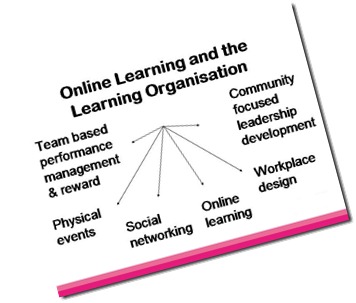
  So I delivered this webinar for Citrix Online today: Online learning and the learning organisation.

I talked about social learning, why this is important, and why despite its importance, we still tend to focus on the learning of individuals rather than social groups such as teams, communities and networks.  And I suggested that the the learning organisation is based on social learning – and the consequent development of Peter Senge’s shared vision and mental models etc.

I then suggested that organisations need to select the appropriate enablers for becoming a learning organisation that suit their particular context and situation.  One of these enablers is online learning and given the title of the webinar, this was the enabler I focused on most.

I also stressed that online learning is probably the most powerful enabler that we have.  Now this webinar was delivered for Citrix Online, and they wanted me to deliver something on online learning, but the title and the link to the learning organisation were my suggestions.  So I do believe what I have just written.

Most of the participants (actually 92% of them) seemed to agree.  But obviously not everyone – and I wasn’t able to fully answer Jacqueline’s question right at the end – why exactly do I think online learning is social?  Jacqueline wrote that she didn’t think this webinar was very social, and I do agree with her.  Partly because I didn’t leave enough time for questions (though I did do a lot better than the last of these I delivered).  And partly, as I stressed in my presentation, online learning probably does need to be combined with other enablers, whether these are physical or technological, eg a Twitter feed or something, to be really social.  I also like the developing use of video within these applications, and long for the day when we’re all connected by Telepresence.

But I still think online learning is key.  And this isn’t just because it’s (at least partly) social, it’s also, as I also said, because it’s virtual, synchronous, co-created and increasingly mobile too.  All of these attributes contribute towards the outcome of better social learning.

Social networking systems is the other key enabler, particularly if they include blogging, podcasting etc too.  The networking function is key in helping people develop the connections and relationships that are the basis for social learning to take place.  And then blogging, podcasting and online learning provide effective ways for learning to take place.

And I absolutely do believe these tools have made the learning organisation much more achievable than when I was more specifically focusing on consultancy in this area about 20 years ago.


If you were on the webinar, I hope you enjoyed it.  I’ve asked Citrix if they can provide your questions I didn’t get to answer, or please add them again (sorry) as comments to this post – and I will answer each one.


You may also be interested in the next webinar I’m doing which is on HR 2.0 and will take place at 3.00pm GMT or 9.00am CST (I’ll be in Houston, TX) on Tuesday 15th March.


  • Consulting - Research - Speaking  - Training -  Writing
  • Strategy  -  Talent  -  Engagement  -  Change and OD
  • Contact  me to  create more  value for  your business
  • jon  [dot] ingham [at] strategic [dash] hcm [dot] com

.

READ MORE - Online learning and the learning organisation


  I’ll be delivering a webinar on Social and Online Learning and the Learning Organisation at 11.00am GMT today.  In this webinar, I’ll be going back to the question I asked at TRU: why does 95% of what we do in HR (here, L&D) focus on individuals (when what’s most important is teams.  Do join me if you can.  And I’ll be posting on my reflections from the webinar later on today.


My next webinar will be on Social HR / HR 2.0 and that will be at 3.00 on Tuesday 15th March.  I hope you’ll join me for that webinar too.


  • Consulting - Research - Speaking  - Training -  Writing
  • Strategy  -  Talent  -  Engagement  -  Change and OD
  • Contact  me to  create more  value for  your business
  • jon  [dot] ingham [at] strategic [dash] hcm [dot] com

.

READ MORE - Learning Organisation webinar today